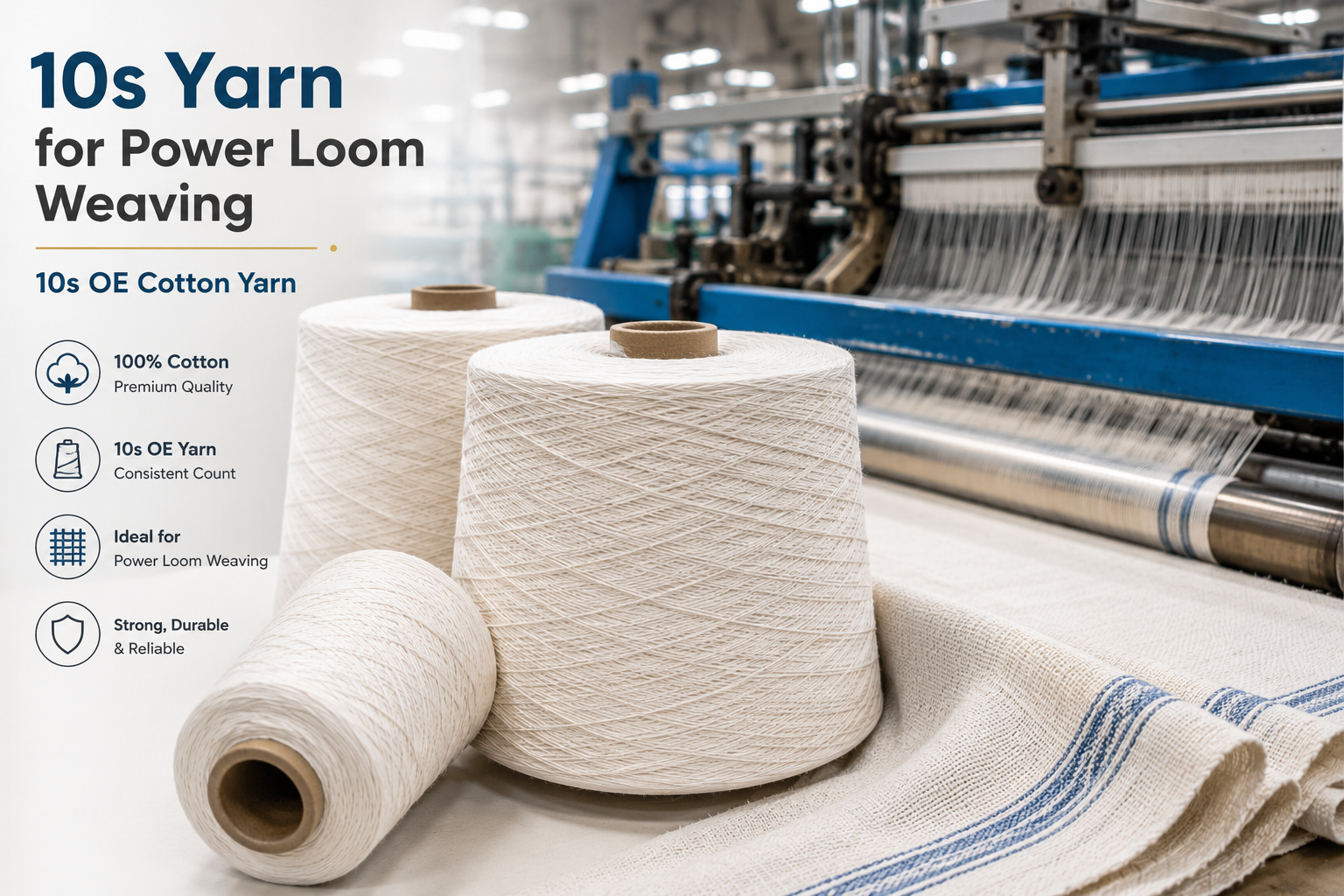
Power loom weaving requires yarn that can handle continuous machine operation while maintaining consistent fabric quality. For many textile manufacturers, 10s yarn for power loom weaving is a practical choice when producing heavier and durable fabrics.
The yarn count, strength, uniformity, and spinning quality all influence how efficiently the yarn performs on the loom. Choosing the right yarn can help reduce unnecessary breakage, maintain fabric consistency, and support smoother production.
For manufacturers working with coarse-count fabrics, 10s OE cotton yarn is one option worth considering.
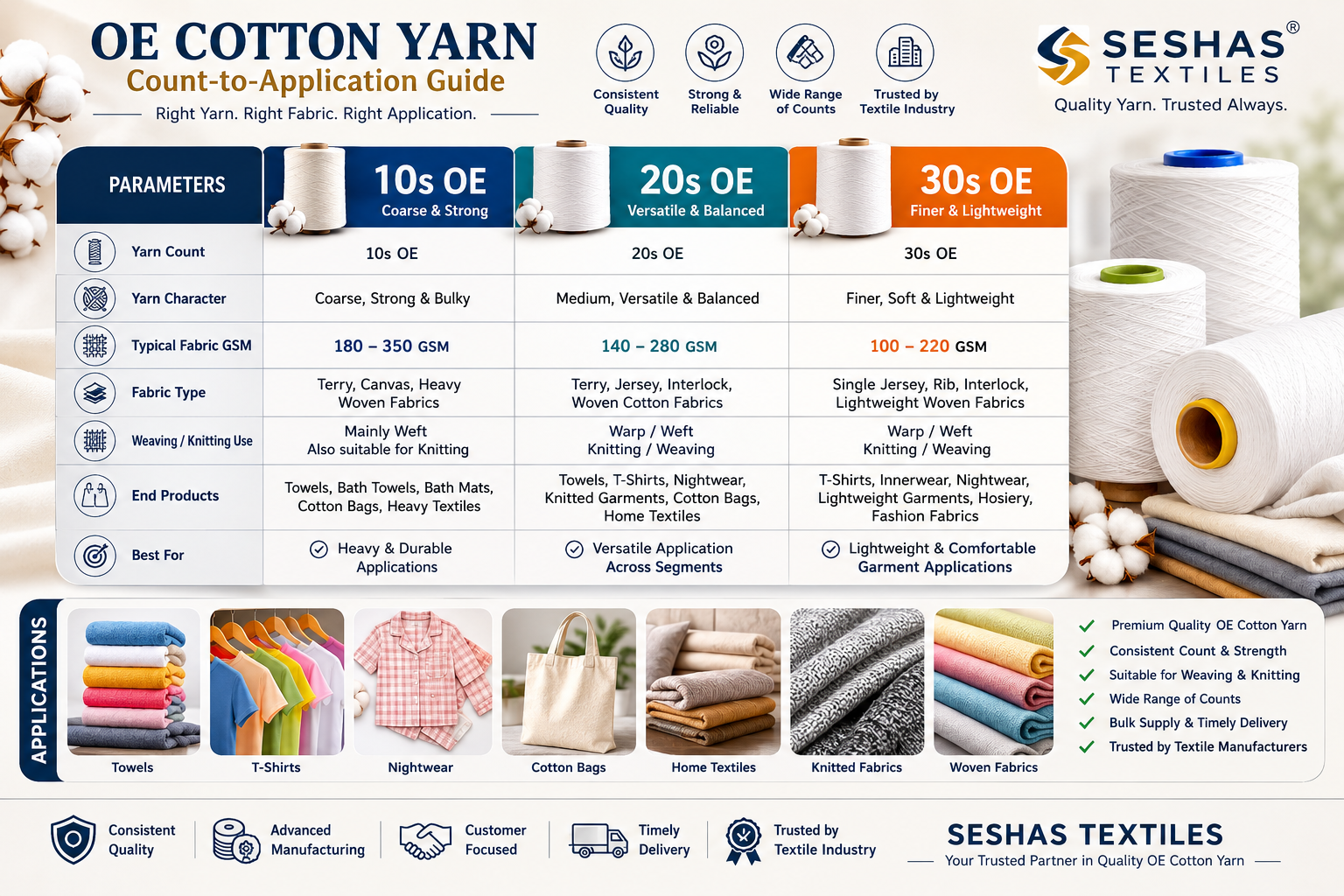
The term 10s refers to the yarn count.
It is considered a coarse yarn count and is commonly used for applications where a comparatively thicker yarn is required. The actual suitability of 10s yarn depends on the fabric design, loom settings, construction, and end use.
Because of its heavier count, 10s yarn can be useful for producing fabrics that require a stronger and more substantial structure.
Power looms operate continuously, so yarn performance matters throughout the weaving process.
A suitable 10s yarn can support:
Consistent weaving performance
Good fabric strength
Stable yarn tension
Reduced yarn breakage
Uniform fabric construction
Efficient production
Better handling during continuous weaving
However, yarn quality should always be evaluated against the specific loom, fabric construction, and production requirements.
Open-End, commonly called OE spinning, is a widely used method of yarn production.
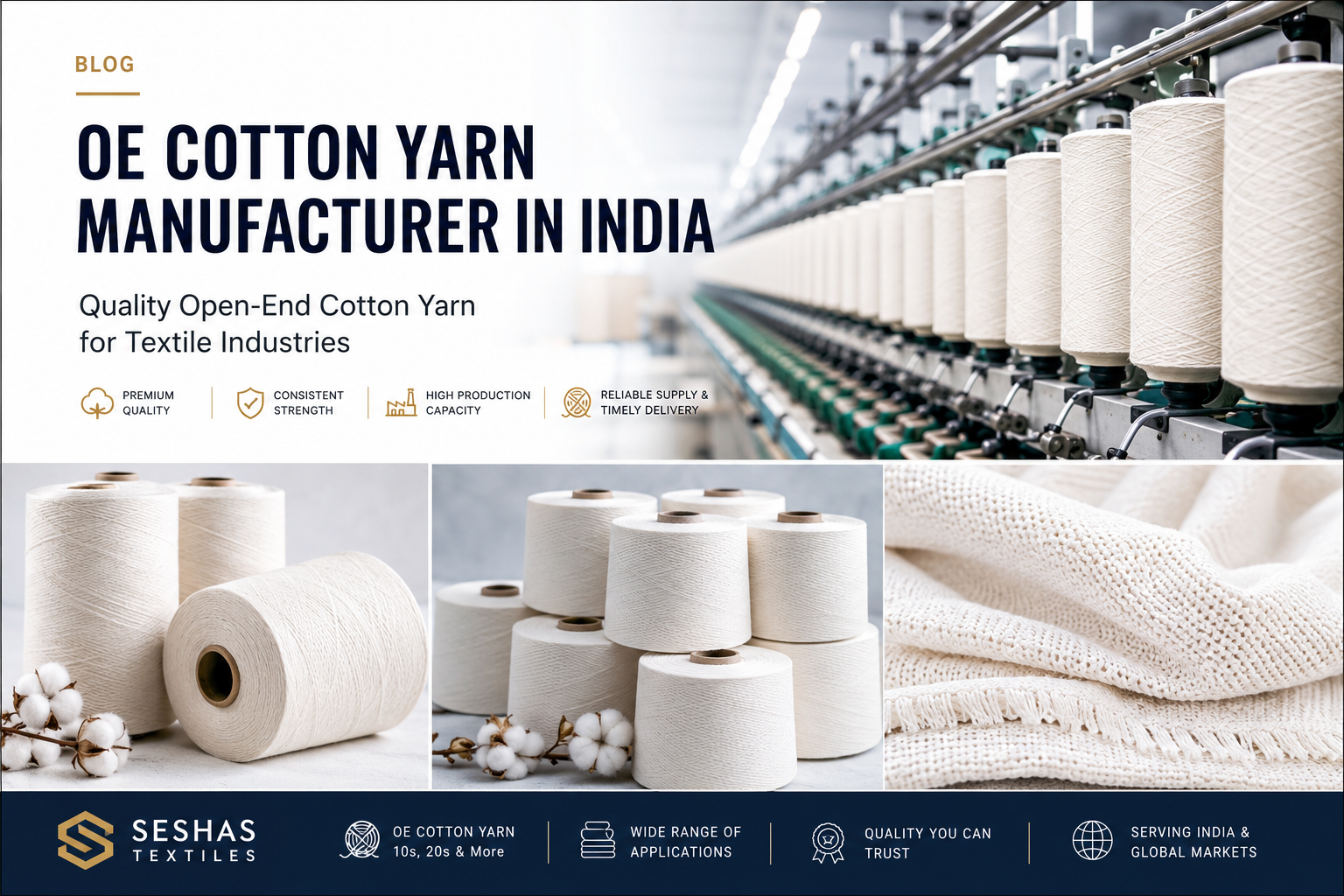
10s OE cotton yarn can be suitable for power loom applications where a coarse cotton yarn is required. Seshas’s Textiles manufactures 10s OE cotton yarn in 100% cotton and supplies it for power loom and handloom weaving applications. The company states a strength specification of 1200+ CSP for its 10s OE yarn.
The yarn can be considered for applications such as:
Power loom weaving
Handloom weaving
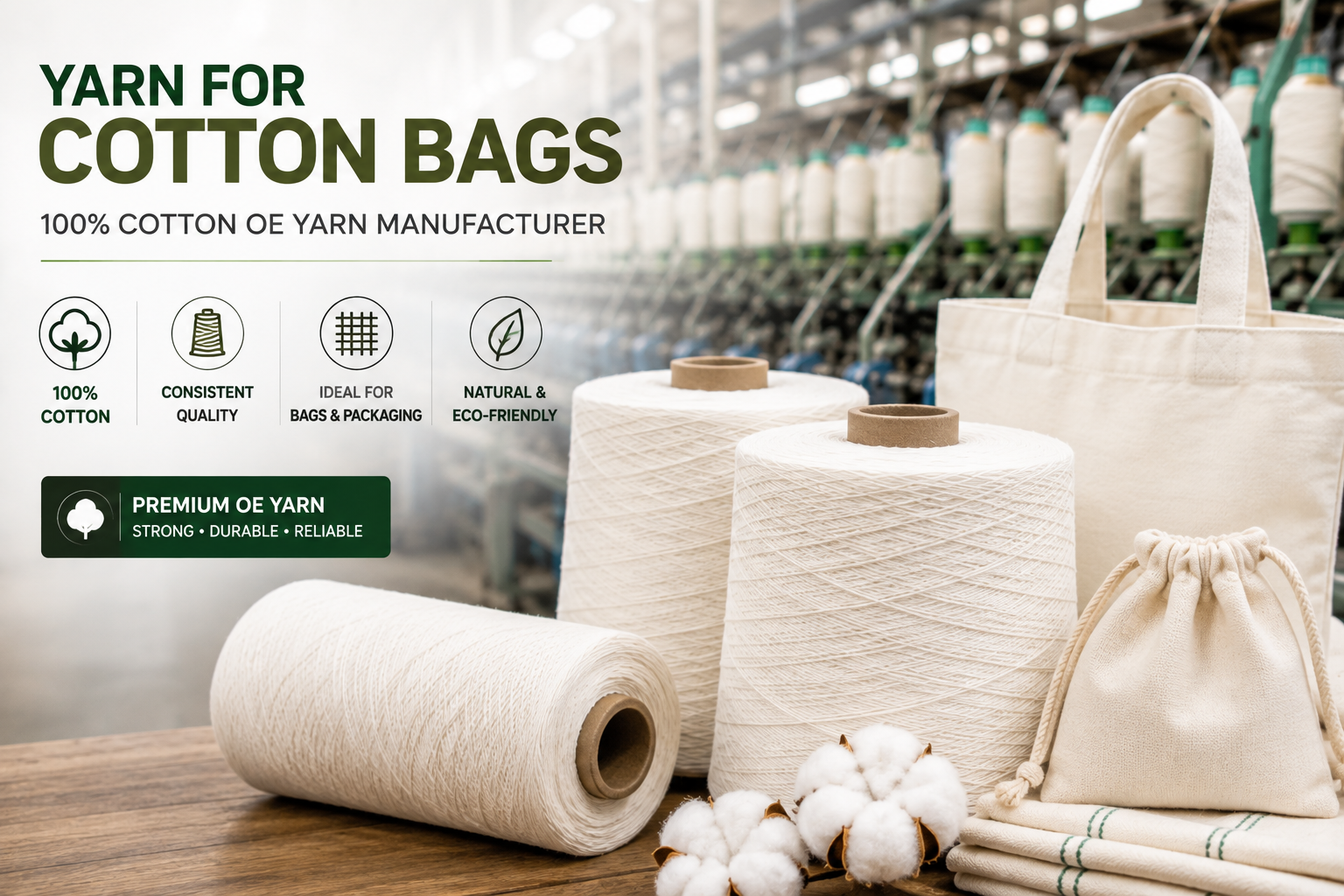
Towels
Home textiles
Industrial fabrics
Doubling
Reeling
The exact yarn specification should be selected according to the intended fabric and weaving process.
Not every yarn performs in the same way on a power loom.
Several characteristics should be considered before purchasing yarn.
Power loom weaving involves continuous movement and mechanical tension.
Yarn with suitable strength can help it withstand the demands of the weaving process. For manufacturers, consistent strength is particularly important when running production for longer periods.
The yarn count should remain consistent throughout the package and across different batches.
Variations can affect fabric construction and may create inconsistencies during production.
Twist influences the behaviour of yarn during weaving.
A consistent twist can contribute to stable yarn performance and help manufacturers achieve a more uniform fabric.
Excessive loose fibres can create problems during processing and affect the working environment around the loom.
Yarn with controlled hairiness and lint can contribute to smoother machine operation.
The way yarn is wound and packaged also matters.
A well-formed package allows the yarn to unwind consistently, which is important for continuous weaving operations.
Power loom fabrics are created by interlacing two sets of yarn: warp and weft.
The warp runs lengthwise through the fabric, while the weft passes across it.
Depending on the fabric construction and loom requirements, 10s yarn may be considered for either direction. The final selection should take into account factors such as yarn strength, loom type, fabric GSM, ends per inch, picks per inch, and the required finish.
This is why textile manufacturers should discuss their exact weaving requirements with the yarn supplier before placing a large order.
The coarse structure of 10s yarn makes it useful for a range of textile applications.
10s yarn can be used in power loom weaving for fabrics requiring a relatively heavier yarn structure.
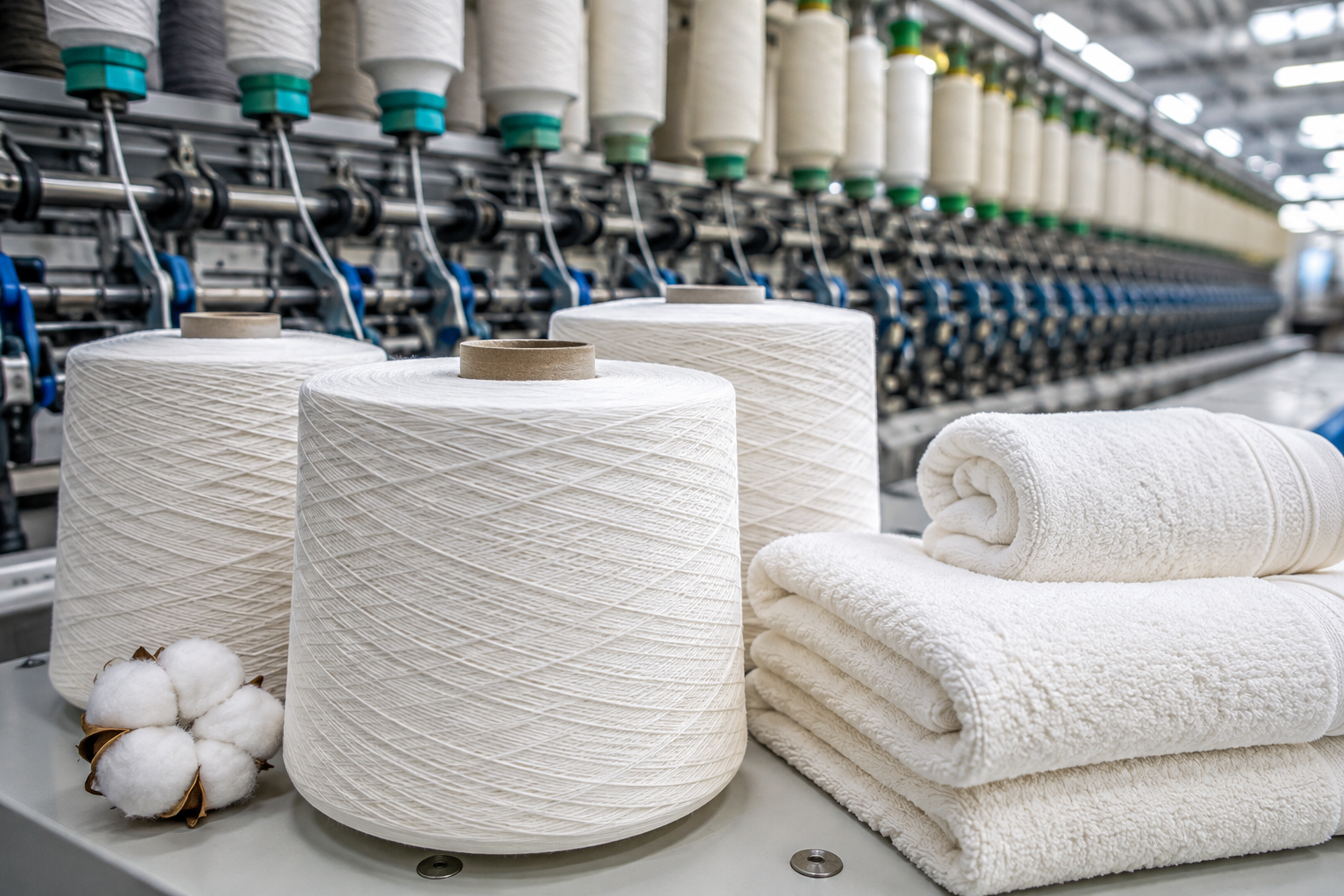
Coarse cotton yarns can be used in towel production where absorbency, bulk, and durability are important considerations.
Depending on the fabric construction, 10s yarn can be used for selected home-textile products.
Certain industrial and utility fabrics require thicker yarns with suitable strength. 10s OE cotton yarn can be considered for these applications based on the required specifications.
Before buying 10s yarn for power loom weaving, manufacturers should look beyond the yarn count.
Consider the following:
Yarn material: Check whether the yarn is suitable for your intended fabric and processing method.
Strength: Make sure the strength meets your loom and fabric requirements.
Count: Confirm that 10s is appropriate for the desired fabric construction.
Twist: Consistent twist can support stable weaving performance.
Quality consistency: Ask for information about batch-to-batch consistency.
Packaging: Choose a package format that works with your loom and yarn handling system.
Supply capacity: For regular production, a supplier should be able to maintain dependable bulk supply.
Seshas’s Textiles is an OE cotton yarn manufacturer based in Rajapalayam, Tamil Nadu.
The company specialises in 10s, 20s, and 2/20s OE cotton yarns and supplies yarn to power loom and handloom weaving units, towel manufacturers, textile businesses, and other industrial users.
For its 10s OE cotton yarn, Seshas’s Textiles specifies:
100% cotton
10s Open-End yarn
1200+ CSP strength
Uniform count and twist
Grey yarn options
Bulk supply
The company also states that its manufacturing process includes raw-material selection, carding, drawing, OE spinning, and quality checks before the final yarn is supplied.
For a power loom unit, production interruptions can affect delivery schedules and operating costs.
A dependable yarn supplier can therefore be an important part of the manufacturing process.
When purchasing in bulk, manufacturers should look for:
Consistent quality between batches
Reliable production capacity
Proper packaging
Clear product specifications
Timely dispatch
Responsive customer support
Seshas’s Textiles offers bulk supply and packaging options for textile buyers, with its product range focused on OE cotton yarn.
Choosing the right yarn is an important decision for every power loom manufacturer.
10s yarn for power loom weaving can be a suitable option when a coarse cotton yarn is required for the desired fabric construction. However, the best result depends on more than yarn count alone. Strength, twist, consistency, packaging, loom conditions, and fabric specifications all need to work together.
For textile manufacturers looking for 10s OE cotton yarn for power loom weaving, Seshas’s Textiles provides 100% cotton OE yarn designed for a range of weaving and industrial applications.
Talk to Seshas’s Textiles about your yarn requirements, bulk quantity, packaging, and specifications.
Choose the yarn according to your loom.
Choose the specification according to your fabric.
Choose a supplier you can rely on for consistent supply.